
Search Engine Optimization and Marketing (SEO & SEM) can be a very complicated process but can also be an extremely valuable tool in gaining new customers and increasing revenue for your business. Beginners may wish to read through our “Important Terms To Know” Section at the bottom of the page to become familiar with some of the terminology and processes involved in SEO and SEM.
Below is an outline of the elements that are involved with SEO and SEM along with pricing and packages for the services that we provide:
SEARCH ENGINE OPTIMIZATION (SEO)
Search Engine Optimization (SE0) involves adding content and editing the code on your website to make it “visible” to search engines. The more “visible” your site is to search engines the higher they will rank you when users search. The SEO process starts by deciding which keywords you want to submit and focus on. These keywords should be the most common terms that visitors would search for when looking for products/services that your business offers. After the keywords have been determined we will then build content and alter the website code to reflect the determined “focus” of the website. When a search engine, like Google, evaluates your website it should have a clear picture of what the sites focus is based on the search engines “Ranking Criteria”. The more pages that are optimized on your website the better your chances of gaining a higher position on a search engines organic ranking.
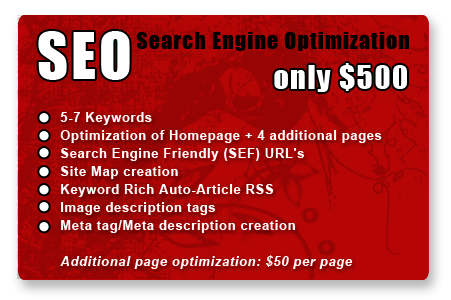
*Discounts may apply for websites that have had optimization work done in the past
Interested? Contact us today with any questions or to get started in our SEO program!
SEO builds the foundation of your website, however, a monthly Search Engine Marketing SEM campaign is often necessary to push your website up the rankings and gain a good position with in search engine organic rankings.
SEARCH ENGINE MARKETING (SEM)
Search Engine Marketing (SEM) refers to efforts made out side of your website, via advertising and link sharing on external websites, with the purpose of driving traffic to your website and increasing your domains search engine organic ranking. Most common techniques include creating “backlinks” by posting blog comments, submitting keyword relevant articles, posting company information in public and private directories, and sharing links. Additional methods include pay per click (PPC) campaigns, microsite creation, video submissions, and shopping cart product submissions for E-commerce sites.
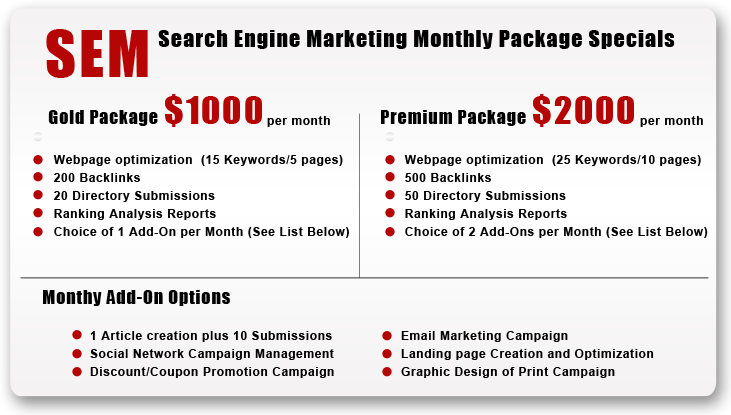
Below you will find 2 SEM packages along with additional services tailored to boost your websites traffic and organic rankings:
This is the best value you will find in the market!
Interested? Contact us today with any questions or to get started in our SEO program!
ADDITIONAL SEM SERVICES
 |
E-commerce Submissions
|
 |
Video Creation and Submission
|
 |
Microsite Creation
|
 |
Pay Per Click (PPC)
|
Interested? Contact us today with any questions or to get started in our SEO program!
IMPORTANT TERMS TO KNOW
Search Engine Optimization (SEO): The process of optimizing a websites code and content to make it more “visible” to search engines and to help increase its organic ranking.
Search Engine Marketing (SEM): The process of marketing a website by creating backlinks, through advertising, social networking, blog/article/directory/video submissions, and Microsite creation etc.
Keywords: Keywords are the most common searched terms that related to your websites/business services and product offerings. Keywords are either defined as”general” (ie. website development) or “specific” (Austin website development). “General” keywords have more websites competing for ranking so they take longer to grow organically. “Specific” keywords can often ascend organically at a faster rate.
Backlinks: The addition of links on external websites with the purpose of driving traffic to a website and increasing search engine visibility.
Organic Ranking: Is the page and position that search engines place your site when specific keywords are searched for. Each search engine has a different method to evaluate their organic rankings. Top criteria includes: Domain age, website traffic, website optimization, number of backlinks, quality/relevancy of backlinks.
Ranking Criteria: Some factors that affect a websites organic ranking are: Keywords being in the pages body content and headers, h1-h6 tags, and bold text, internal links, having search engine friendly (SEF) URL’s, Image tags, keyword density, and having a site map. Search engines also evaluate factors such as, age of the domain name, site traffic, and number of backlinks associated with a website.
Pay Per Click (PPC): Pay per click is an advertising technique that involves biding for a price that you are willing to pay each time a user clicks on an advertised link to your website. Bids often range from $.01 to $5 a click. The most common and effective form of pay per click is by using Google’s Adwords where the top bidders get advertising placement on the right side of Googles search results page.
Blog Commenting: Involves commenting on blogs and articles that are relevant to your business and keywords. This process creates backlinks as well as drives traffic to your website.
Article Submission: Writing and submitting articles to blog style websites the contain content relevant to your websites keywords can be a valuable tool in SEM. Articles not only create backlinks to your website but it also provides readers with product/service information and can be effective in driving traffic to your website. The more popular and relevant the website is where your article is posted the more weight it has with search engines, helping your organic rankings.
Directory Submissions: Perhaps the most effective method of creating backlinks and driving traffic to your website is directory submissions. The more popular public directory sites like Yelp, Yellow Pages, Mantra, DMOZ, and Google Maps can contain company information, photographs, and user reviews and can have a tremendous impact on both your website traffic and your organic rankings.
Social Networking: Social Networks are the largest growing trend on the internet today and many companies are capitalizing on their tremendous user groups and ability to rapidly spread information. Popular social networking sites such and Facebook, Twitter, and Linked In can give your company the ability to advertise and market to specific demographics who have shown interest in your businesses industry. Because of the enormous amount of traffic that flows through social networks, creating postings, backlinks, and groaning your followers can have a valuable effect on your sites traffic and organic rankings.
Microsite: A “mini website” that focuses on a specific service, product or section of your business. Microsites can have their own unique domain name or can be set up as subdomains of your current webiste. (ie. www.MicrositeName.com or microsite.CurrentWebsiteName.com) They allow you to focus different keywords and SEM campaigns on specific areas of your business and can grow that sectors search engine rankings more rapidly. They also contain backlinks to your main website helping its visibility grow as well.